.svg)
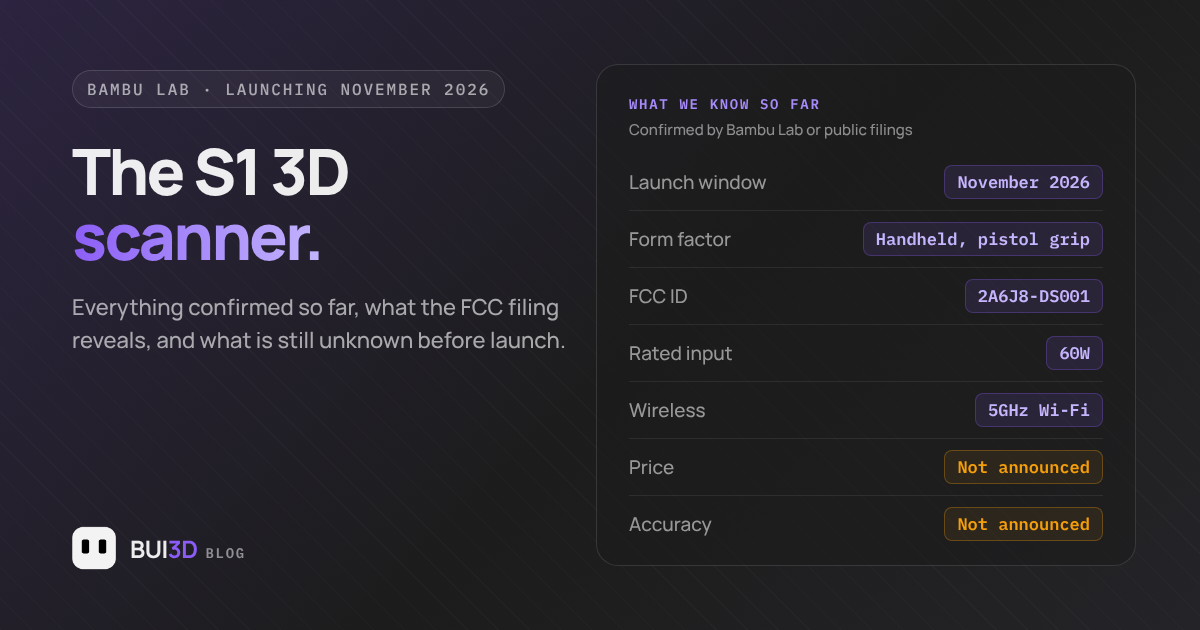
What Bambu Lab has actually confirmed
The official announcement is deliberately thin. Here's everything Bambu Lab itself has put its name to so far:
- The name: S1 3D Scanner, Bambu Lab's first scanning product.
- The launch window: November 2026, listed as "coming soon", with no exact date.
- The form factor: a black handheld scanner with a pistol-style grip, shown only partially in the teaser image.
- The pitch: "Easy in Hand. Pro in Every Scan." and "Create from your world. Start with a scan."
- The reasoning: Bambu Lab describes scanning as "a natural extension of our ongoing vision", following its 3D printers and laser cutter, and says the S1 is built to tackle two things that have held 3D scanning back: unreliable wireless connections and steep learning curves.
That's the full list. Price, scanning technology, accuracy, colour capture and software have not been announced.
What the FCC filing reveals
Before the teaser, the scanner appeared in an FCC filing dated 22 September 2026 under the ID 2A6J8-DS001, which is where most of the hard details come from:
| Detail | From the filing | What it suggests |
|---|---|---|
| Product category | 3D Scanner | Confirms the device type ahead of the teaser |
| Rated input | 60W | A lot of power for a handheld, and no battery is shown on the label |
| Wireless | 5GHz Wi-Fi | Likely used to send scan data to a computer, though the workflow isn't confirmed |
| Label drawing | Flat area near the top of the handle | Possibly a screen, but the teaser doesn't confirm one |
| Use | Indoor use | Reported from the accompanying certification |
FCC labels confirm what a device is certified to do, not how it will be sold. A 60W input with no battery on the label points towards mains or power-brick operation, but Bambu Lab hasn't said how the S1 is powered or whether it needs a PC connection to work.
The SCANTECH connection
The most interesting background detail isn't from Bambu Lab at all. Bambu Lab's parent company reportedly signed a framework agreement on 29 January 2026 with SCANTECH, a Hangzhou-based industrial scanner maker that sells under the SCANOLOGY brand. The reported arrangement is that SCANTECH manufactures and Bambu Lab sells consumer scanners, over a five-year term.
That makes it likely, though not confirmed, that SCANTECH is behind the S1's hardware. Neither the FCC filing nor Bambu Lab's teaser names SCANTECH. Some have also noticed that SCANOLOGY's 3DeVOK MT Gen2, a wired scanner using blue and infrared lasers, shares the same 60W rating. A matching power figure proves nothing about shared technology, though, so treat that as an interesting coincidence until Bambu Lab says otherwise.
How much will the S1 cost?
Nobody outside Bambu Lab knows yet. What we can say:
- Community guesses cluster around $1,000, with some closer to $2,000.
- Comparable handheld scanners in this class tend to sit somewhere between $1,500 and $4,000.
- SCANOLOGY's 3DeVOK MT Gen2 costs $8,299, which is why some have warned against assuming a budget price if the S1 shares industrial roots.
Bambu Lab's track record points the other way. The X1 Carbon, the A1 and, most recently, the X2D (from $649) all undercut the market they entered. If Bambu Lab applies the same thinking to scanning, the S1 is more likely to land at the lower end of that range than the top. Until there's an official number, though, any price you see is a guess.
What Bambu Lab says it's for
Bambu Lab has named a handful of use cases, and they're broader than you might expect from a printer company:
- Scanning vehicles to design custom wraps.
- Capturing collectible figures for replication or restoration.
- Preserving cultural artefacts for virtual and augmented reality.
- Scanning the human body for customised clothing, footwear or assistive devices.
That last one lines up with Bambu Lab's current Make for Good accessibility design contest on MakerWorld. 3D Adept reports that the contest's winners will be among the first S1 users, though the contest page itself doesn't yet list the scanner as a prize.
What a scanner changes for Bambu Lab printer owners
For most people reading this, the real question is how a scanner fits into a printing workflow. Even before the specs arrive, a few things hold true for any scanner:
Scans aren't print-ready files
A scanner produces a mesh of the surface it can see. Holes where the scanner couldn't reach, noise, floating fragments and a missing flat base are all normal, and each one needs fixing before a slicer will turn it into a clean print. How much of that cleanup Bambu Lab's software does automatically will be one of the biggest factors in whether the S1 really is "easy in hand".
Scale is everything
The whole point of scanning a real object, such as a replacement part, a bracket or a fitting, is getting it back at the right size. A mesh that's been rescaled by a unit mix-up or an export setting looks completely normal until it comes off the plate wrong. It's the same problem we covered in duplicate and corrupted print files, and it becomes far more common once you're producing your own meshes rather than downloading finished ones.
Your file library will grow fast
Scanning is iterative: a first pass, a second from a better angle, a cleaned-up version, a version with a base added. Without some discipline you end up with half a dozen near-identical files and no idea which one printed well. Naming scans by object and date, and keeping only the final cleaned mesh next to the raw scan, saves a lot of guesswork later.
Material choice still matters
Scanned replacement parts are often functional parts, which means the filament matters as much as the geometry. A perfect scan of a clip printed in the wrong material, or from a damp spool, still fails. Our filament settings guide and filament drying guide cover the print side.
What we're still waiting to find out
- The price, and whether there will be bundles or a combo with a turntable or other accessories.
- The scanning technology: laser, infrared, structured light or a combination.
- Accuracy and resolution, which will decide whether it suits small detailed parts or larger objects.
- Colour capture, which matters for figures and artefacts but not for most functional parts.
- Power and connectivity: whether it needs mains power, a power bank or a PC connection to work.
- The software, and how directly scans move into Bambu Studio for printing.
- The exact launch date and which regions, including the UK, get it first.
Should you wait for the S1?
If you're about to buy a handheld scanner and the purchase can wait a few weeks, waiting is the sensible move. At worst, you'll have one more option to compare, and at best, a scanner designed around the printers you already own.
If you need a scanner for a job right now, the S1 isn't a reason to put the work off: none of the specs that matter are public yet, and early demand for a new Bambu Lab launch is usually high, so stock may take time to settle. Buy what does the job today, and judge the S1 on its published accuracy and price once they're out.
Bambu Lab has confirmed a new flagship printer, the H3C tool changer, with a reveal on 3 November at 2pm UK time. Here's everything we know.
Timeline so far
| Date | Event | Status |
|---|---|---|
| 29 Jan 2026 | Framework agreement between Bambu Lab's parent company and SCANTECH | Reported |
| 22 Sep 2026 | FCC filing for device DS001, categorised as a 3D scanner | Public filing |
| 12 Oct 2026 | Official S1 teaser from Bambu Lab | Confirmed |
| November 2026 | Launch window | Confirmed, no exact date |
Frequently asked questions
When is the Bambu Lab S1 3D scanner released?
Bambu Lab has given a launch window of November 2026, described as "coming soon". No exact date has been announced.
How much will the Bambu Lab S1 cost?
Bambu Lab has not announced a price. Community guesses cluster around $1,000, but nothing is confirmed, and the price will depend heavily on the scanning technology inside.
Is the S1 made by SCANTECH (SCANOLOGY)?
Not confirmed. Bambu Lab's parent company reportedly signed a framework agreement with SCANTECH, the industrial scanner maker behind the SCANOLOGY brand, in January 2026. Neither the FCC filing nor Bambu Lab's teaser names SCANTECH.
Does the Bambu Lab S1 have a battery?
Unknown. The FCC label shows a 60W rated input and no sign of a battery, which suggests it may run from mains power or a power brick, but Bambu Lab has not confirmed how it is powered.
Will the S1 work with Bambu Lab 3D printers?
Bambu Lab has not published its software workflow yet. It has said scanning is a natural extension of its printers and laser cutter, and its tagline is "Create from your world. Start with a scan", so a scan-to-print workflow is the obvious expectation, but the details are not confirmed.
Already printing on a Bambu Lab?
FilamentLab is built exclusively for Bambu Lab printers: over 1,000 verified filament presets, AI failure diagnosis, live humidity monitoring and spool tracking, plus BUI3D Vault for catching duplicate and wrongly scaled files in your library.
Explore FilamentLabSources: Bambu Lab: S1 3D Scanner · Tom's Hardware · 3DBite · All3DP · 3DPrint.com · 3D Adept